Reference engagement · West Sacramento cannabis distributor
5 weeks. 5x output. Fully compliant.
LBS Distribution, West Sacramento. Engagement dates: 03/23/2026 through 04/21/2026.
At a glance
Engagement outcomes.
Sustained label rate
Paid systems made unnecessary
Spooling time on a 3,700-label job
Error recovery time per stoppage
Simultaneous machine count
Operator footprint of the new pipeline
Written standard operating procedures
Context
What was happening when I arrived.
Production was stalled. Pre-engagement run-log baselines show known but unresolved errors: E1000 (“print signal sent too close together”), E1005 (“print limit exceeded”), E4010, “communication loss.” All treated as printer-side faults and chased through Videojet support without resolution. Spooling speed had been blamed on disk space, then SQL Express, then BarTender configuration, then Acumatica throttling, then the hosted print server. Each fix was tried. Each landed. The floor stayed at roughly sixteen labels per minute.
Operators had developed a workaround: burning physical labels for visual validation before committing to a full run, because the system had no pre-print preview surface. The workaround had become normal. It was wasting label stock, but more importantly, it was masking the real failure. Nobody had visibility into the field-map state on a per-run basis.
The integration vendors were each insisting their component was working as designed. They were each correct. The problem lived between them, in handoffs no single party owned.
Method
What I did, in order.
- Day 1 (March 23), floor walkthrough. Traced the Acumatica → BarTender → DataFlex chain end-to-end with the operator. Found a wrong port number in the integration config the same morning. The vendor's deployment had passed checklists but was pointing at port 8082 incorrectly. Same day: tied E1000 to a conveyor-belt-versus-laser-detection timing mismatch and got it adjusted on the spot. First stable production run after the Day-1 fixes hit 3,539 labels at 20/min, three times the previous best.
- Days 2 to 3: trace failures to root cause, document for vendors. Sustained an 80–100/min single-operator rate on the remainder of that run once the buffer established. Traced the 8,000-label failure pattern to a 1024 MB SQL Express ceiling on BarTender Pro. Default verbose logging was eating ~90% of the database before label data started loading. Escalated to the print-server vendor with the evidence they needed to fix what was theirs. Built a custom bulk-uncheck script to preserve batch-record integrity on failed mid-batch runs.
- Days 4 to 7: root cause forced into view. Spooling regressed back to 16–17/min on March 26. Vendors blamed each other. On the April 1 perception-vs-reality blind test, the operations team reported Acumatica had “slowed down” due to spooling. Spooling had been off for an hour. On April 3, on the joint vendor call, I drove the room to the math: the Acumatica-to-BarTender integration sends one HTTP request per label. 5,000 labels × ~3.5 seconds round trip, sequential, equals 16–17 per minute exactly. Every prior fix had been correct in scope and irrelevant to the bottleneck.
- Days 8 to 14: build only what had to be built. Stopped waiting for the integration vendor's batch-dispatch redesign. Built a Chrome extension augmenting Acumatica with pre-print preview and direct-to-printer dispatch. April 6: a 3,700-label job that previously took 5+ hours spooled in under a minute. April 7: discovered DataFlex 6330 printers expose ZPL Emulation on TCP port 9001. Raw ZPL over LAN, no print-server middleware required. April 9: end-to-end direct ZPL confirmed on all four printers.
- Days 15 to 30: warehouse rollout, fleet tuning, and SOPs. April 15: live in production on three of four printers. First full operator-driven production day. April 16–17: per-printer workstation queue architecture across four Dell Latitudes, recovered from server-room inventory and reimaged. April 20–21: fleet-wide CLARiTY config diff caught uniform drift on
RecordBufferMaximumat factory default 1000 (schema ceiling 10,000); bumped fleet-wide. SOP library built out from zero to 54 numbered procedures across nine operational categories. The warehouse had no written SOPs when I arrived. End-of-engagement: all four printers running at full capacity, zero errors, seven workstations on the new pipeline.
A worked example
One procedural fix I caught on the floor.
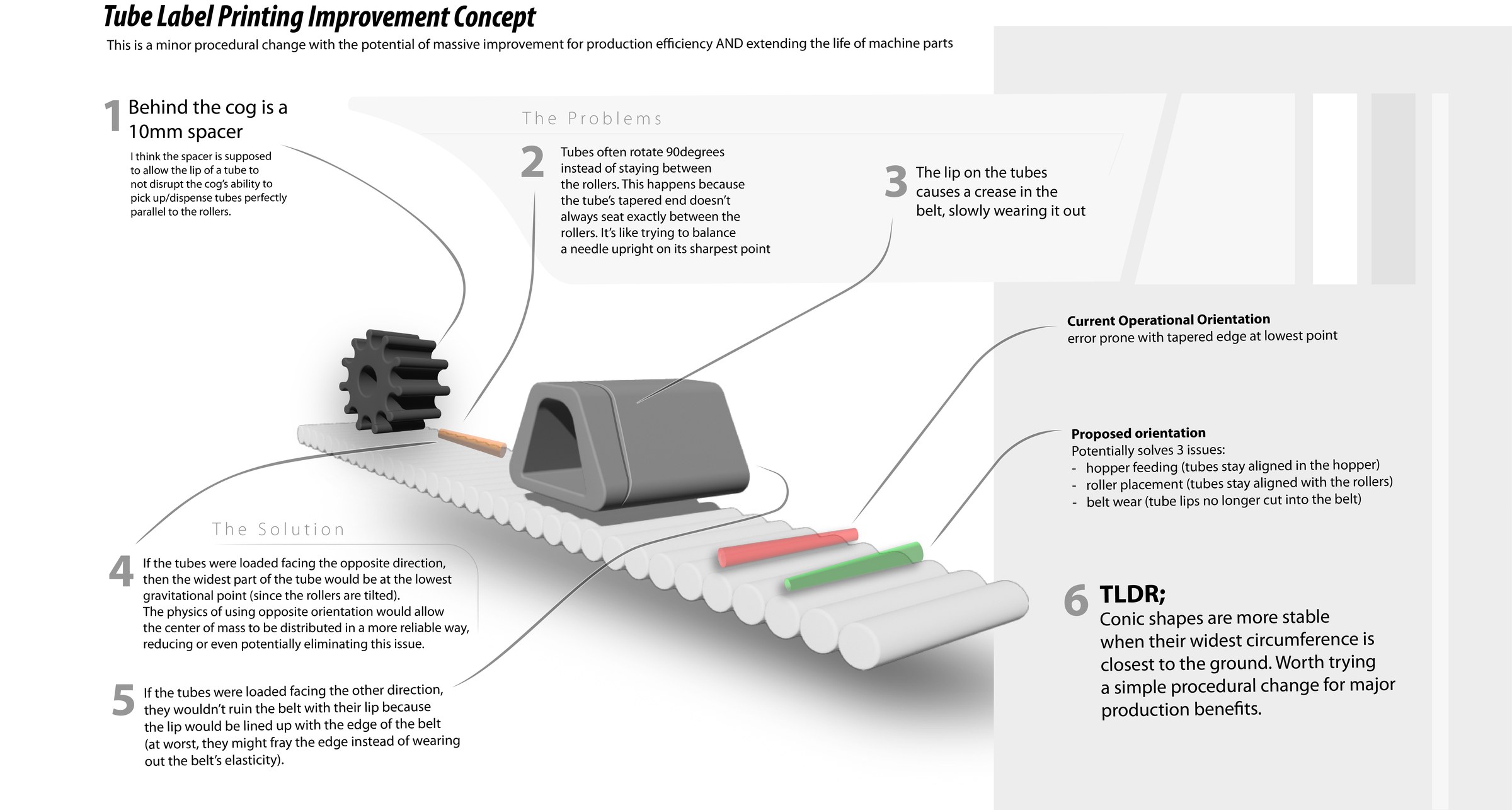
Day-one walkthrough surfaced a small mechanical issue that wasn't on anyone's bug list. The tube labeler was wearing through belts faster than it should and dropping tubes off the rollers at random. Standard read: wear part, replace it, tune the hopper. Closer look: the tubes were being loaded with the tapered end down, which put the unstable point of a conic shape at the lowest gravitational point. Reverse the loading orientation, widest circumference toward the floor, and the same physics that destabilizes a needle on its tip becomes the thing that stabilizes a tube on its base.
Three problems disappear at once: hopper-feed misalignment, roller seating drift, and the tube lip cutting a slow crease into the conveyor belt. The fix is procedural, not capital. The diagram below was produced on-site, the same week, to walk the warehouse floor through the change.
The tool that retired two paid systems
Bacumatica, in one screenshot.
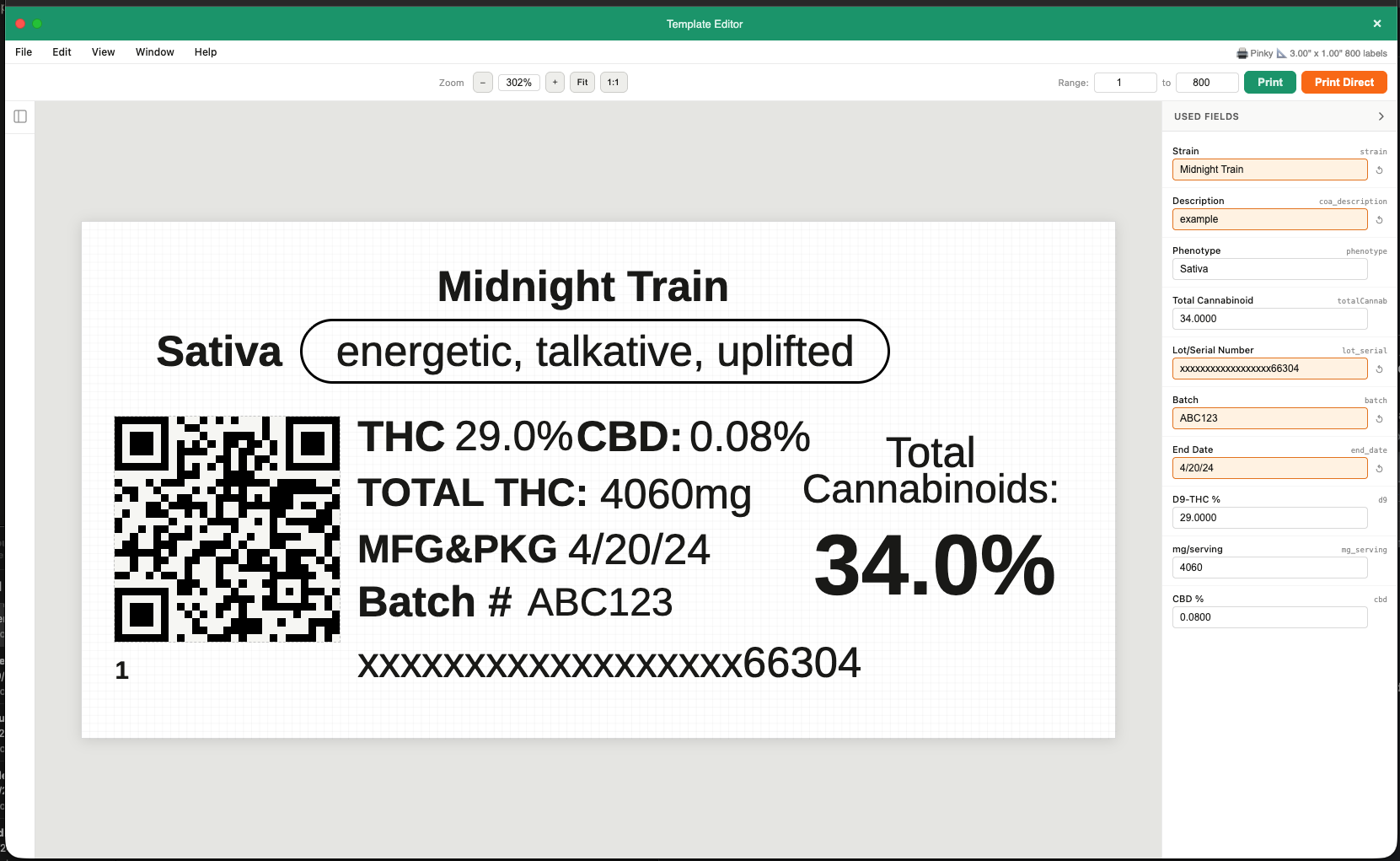
The Chrome extension below is what replaced BarTender Pro and made the hosted print server unnecessary. It runs inside the operator’s existing Acumatica browser tab. No new app to log into, no new credentials, no extra screen for the floor team to learn.
The Template Editor (shown) is the BarTender designer replacement. Operators or compliance staff can build, edit, and lock label templates in a browser. Field bindings on the right pull live from the Production Order, the Final CoA, and the Stock Item record (the cannabinoid percentages, the Metrc retail-ID URL, the lot/serial, the strain, the batch, the dates) with no transcription anywhere in the loop. The preview is WYSIWYG against the actual printer output. Print Direct (the orange button) sends ZPL straight to the warehouse printer over the LAN.
What the screenshot doesn’t show, in plain language:
- Direct-to-printer dispatch. Print Direct opens a TCP connection to the printer at
:9001(DataFlex ZPL Emulation) from the warehouse PC. ZPL goes straight from the browser to the printhead over the warehouse LAN. No middleware, no print server, no driver install. The previous architecture round-tripped every label from Sacramento to Florida and back. This one stays on the warehouse network. - Live cannabinoid-inflation alert. When the CoA panel sees Total THC equal to D9-THC, it fires a red flag in the operator’s view before the print job starts. That’s the same data pattern that produces the verbatim DCC recall language “Inaccurate Labeling (Cannabinoid inflation)” on the state portal. The mechanism is explained here.
- Hot-update without reinstalling. The extension shell is sideloaded once on each warehouse PC. The working JavaScript and the editor itself are server-hosted. A fix written in the evening is live for the next operator’s first label of the next shift, with zero IT touch on any of the workstations.
- Pre-print field validation. Every label-bound field is checked before any ZPL is generated. A missing CoA value surfaces an inline editable input that previews live. The operator types, sees the corrected label render, prints. No round-trip back to the ERP.
- Live printer status in-tab. The Zipher protocol is polled in parallel during a run. The operator sees printed-vs-sent counts and per-printer state for the whole fleet, in the same browser tab they’re working in.
The screenshot is one screen of a tool that handles label-template authoring, live data binding, pre-print validation, ZPL rendering, multi-transport printer dispatch, and fleet status. It is genuinely the surface that retired both paid systems.
This implementation is purpose-built for the LBS environment. The architecture (in-browser editor, server-hosted JS, direct LAN dispatch) is portable. Reusing it at another distributor would mean a configuration extraction pass, not a rebuild.
Deliverables
The technical work, named honestly.
- Bacumatica. Chrome extension augmenting Acumatica with a visual JSON template editor, a pre-print preview surface, and a direct-to-printer dispatch path. Replaced the BarTender Pro license entirely and made the hosted print server unnecessary. Manifest V3 service worker, MAIN- and ISOLATED-world content scripts, an offscreen document for the long-running print spooler, and a server-hosted JS payload so updates deploy to every warehouse PC without reinstalling the extension. JSON template format replacing the BarTender
.btwtemplate library. - Direct-to-printer ZPL pipeline over TCP port 9001 (DataFlex ZPL Emulation), bypassing the BarTender server and the hosted print-server dependency entirely. QZ Tray (open-source, LGPL) as browser-to-printer transport.
- Per-printer workstation routing across 4 Dell Latitudes, hard-bound per station. Recovered from server-room inventory; three wiped and reimaged, one set aside with a shorted board.
- CLARiTY tuning across the Videojet DataFlex 6330 fleet. Per-printer drift caught (
JobUpdateQueueat 1 vs. tuned 20 on a sister printer); fleet-wide drift caught (RecordBufferMaximumat 1000 vs. schema-recommended 10,000). - ZPL renderer absorbing seven distinct DataFlex quirks:
^FNaccumulation across stored-format recalls (resolved by emitting full ZPL per label),^BYpersistence (forced reset before every barcode), required^PQ1,0,1,Yon every label (otherwise last label becomes a standing job),^GBrounded-corner silent ignore (rendered to bitmap), font cap-height scaling on TTF substitution, border-thickness mismatch between editor and ZPL, printer trimming bounding box to ink extent (handled with invisible black corner pixels). - A 54-SOP procedural library built from zero. The warehouse had no written SOPs when I arrived. By end-of-engagement: 54 numbered SOPs organized into nine categories (Daily Operations, Job Issues, Connectivity, Acumatica & Extension, Compliance & Data, Physical Operations, Maintenance, Reference, plus an explicit Placeholders section). Most are written end-to-end. The rest are populated as placeholder slots that route a reader to the specific staff member who holds the knowledge, so they can be filled in by the right person rather than guessed at by me. The library lives in the warehouse-tools help system and is searchable from every workstation.
What this proves at the practice level
The diagnostic process is reproducible. The work followed a structured sequence: observe, document for vendors, give vendors the chance to own their gap, build only when waiting becomes more expensive than building. That sequence is portable to any distributor with the same regulatory exposure. The April 3 root-cause moment didn't require deep cannabis-industry expertise. It required end-to-end visibility across four vendors and the willingness to do arithmetic on the floor.
The cross-vendor architecture work is genuinely scarce. It requires software, hardware, and operator-on-floor capability in one person. Most consultancies pick one of those three. Most software vendors can't speak to operators. Most operators can't write a Chrome extension that talks to a Zebra over QZ Tray, or read a CLARiTY schema closely enough to spot a fleet-wide drift that a per-printer diff missed. The gap between those three skill sets is where I work.
A note on language
I didn’t know ZPL when I started this engagement.
The direct-to-printer ZPL pipeline that became the load-bearing technical artifact of this engagement was written in a language I had not used before March 23, 2026.
I learned ZPL over a weekend. By April 7 the pipeline was running end-to-end on all four printers. By April 9 it was production-ready. By April 21 it was carrying the full warehouse load. The seven distinct DataFlex quirks listed in the deliverables above (^FN accumulation, ^BY persistence, the required ^PQ1,0,1,Y on every label, the ^GB rounded-corner silent ignore, and the rest) were all caught and worked around in the same window.
This is not a brag. It is the reason the practice positions as language-agnostic. After a dozen or so languages, they stop being separate skills and start being variations on the same skill: different grammar, different punctuation, the same underlying problems of state, control flow, data shape, and side effect. Picking up a new one for a specific job stops being a multi-month investment and becomes a weekend.
The implication for an operator: when an engagement scope surfaces a language or protocol I haven’t used before (ZPL, Zipher, EPL, a vendor’s proprietary scripting layer, an ERP’s embedded query dialect) I don’t punt to a sub-contractor or pad the timeline. I learn it inside the engagement window and ship the work. The capability scales with the practice, not with how the practice happened to spend the previous decade.
Schedule a 30-minute call
Thirty minutes. No slides. If an engagement does not make sense, I will tell you on the call.